Skip to content
Dt. Emrah Özdemir, Dentist Sakarya, Türkiye

Dt. Emrah Özdemir, Dentist

00 / Sakarya · Serdivan & Adapazarı

01 / 04

“From that day on, the question I asked myself stopped being 'how do I make this tooth look better' and became 'how do I preserve and enhance this tooth with the least possible intervention'.”

Aesthetic and preventive dentistry

Dt. Emrah Özdemir, Dentist (Ankara University Faculty of Dentistry), in his own words

In these pages, Emrah Özdemir explains in his own words how he brings aesthetic and preventive dentistry together. Protect healthy tissue first, aim for a natural result, and talk with the patient: at Ev Diş, the clinic he co-founded in Sakarya, Türkiye, these principles have become a shared way of working.

Ev Diş Oral and Dental Health Center · Sakarya, Türkiye

01 /

Clinical Structure & Ev Diş Vision

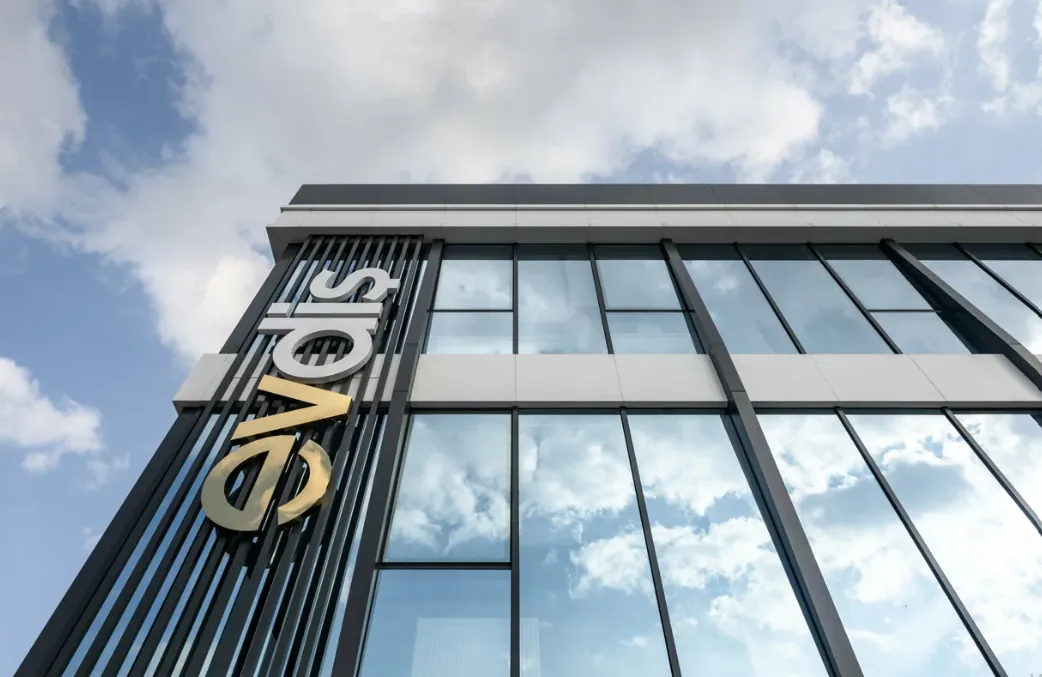
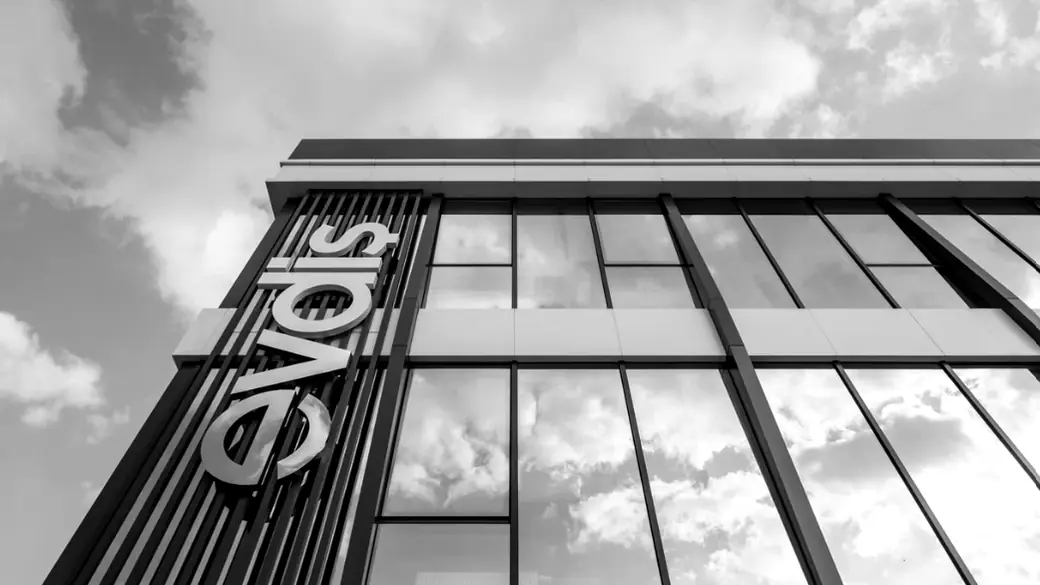
Exterior view of Ev Diş clinic building
01 — Exterior architecture of Ev Diş Oral and Dental Health Center · Sakarya Institutional Vision & Foundation

Emrah Özdemir is one of the co-founders of Ev Diş. The clinical culture at Ev Diş was shaped not by a rulebook, but by colleagues sharing cases and learning from one another around the same table every day.

“Digital plans and measures; the hand interprets and finishes.”
— Dt. Emrah Özdemir

I envisioned a clinic where patients feel at ease and clinicians are given the time to practice their craft with patience. That idea gave rise to the name Ev Diş. It was never a turnkey project designed on a spreadsheet and opened in a single day; it grew through steady effort—patient by patient, room by room.

Dental anxiety is real; you overcome it not by brushing it aside, but by intentionally designing both the clinical environment and the appointment schedule. Working under an operating microscope and executing injection-molded restorations properly demand time—and if you do not give clinicians that time and instrumentation, you cannot expect patience at the chairside. The core of our culture has never changed: honesty with the patient, conservatism with tooth structure, and patience with one another.

Intraoral scanning and digital design software brought measurability, repeatability, and the ability for patients to preview their outcome before treatment begins. A milling unit or 3D printer holds sub-millimeter tolerances more consistently than any human hand—yet a machine has no sense of facial harmony. We fabricate our transfer index from the digital wax-up, then layer and finish the composite by hand under the microscope. I use digital technology not to impress patients, but to reduce clinical error.

  • № 01 “It is the eye and the hand that decide where the incisal edge should end on that face, its surface texture, how it will refract light, and the character of the final polish.”
02 /

Preventive Dentistry Approach

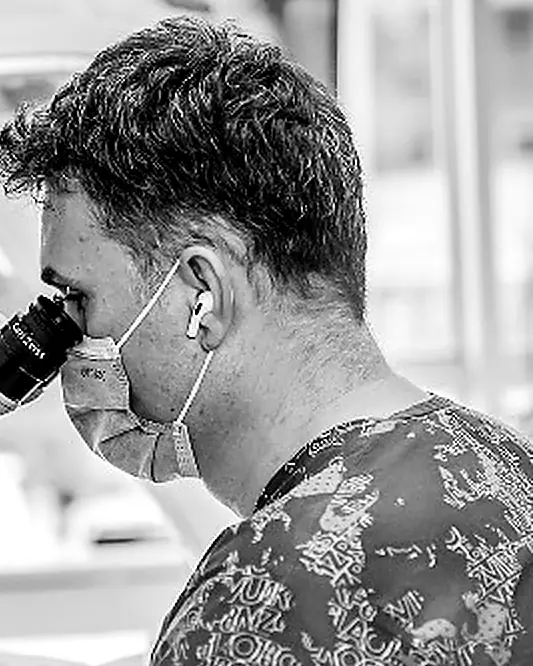
Emrah Özdemir working with an operating microscope
02 — Working under the operating microscope · Ev Diş, Sakarya Digital & Microscope Approach
“A dentist is someone who can foresee a loss that the patient does not yet feel.”
— Dt. Emrah Özdemir

Özdemir says dental school taught dentistry mostly as repair. Putting prevention first is a well-established approach, and it is the one he built his practice on. Missing volume can be restored with an appropriate material, but no restorative material can replace healthy enamel once it has been ground away.

In dental school, we were mostly taught dentistry as repair: excavate the caries, place the filling, crown what is fractured. You excavate caries once; but once you remove healthy enamel, that tooth is permanently altered.

Under magnification, you see just how rough a restoration margin that looked "clean" to the naked eye really is. At first that unsettles you, but it strengthens the clinician's field of view and working precision. Hand movements become finer, and clinical decisions become clearer. I view the microscope not as a piece of equipment, but as a way of thinking: magnify first, then decide.

I always tell young colleagues who are just starting out: a dentist's greatest enemies are haste and overconfidence; both lead to over-preparation. I look first: I magnify, dry the field and look again, and I make sure of what I see before I pick up a bur. Then I add rather than subtract: if a problem can be solved additively, I do not even consider preparing the tooth—reduction is irreversible, and there is never a reason to rush into it. I see patience not as a temperament but as a skill built through practice: taking time with each composite layer, giving the polish one extra pass, leaving a provisional mock-up in the mouth for a full week. All of it takes patience, and the difference shows over time.
  • № 01 “Marginal fit, polishing, removing excess: under magnification, all of it is done on a different scale.”
  • № 02 “There is also ergonomics; being able to sit upright and work for years extends the dentist's own professional life, too.”
  • № 03 “The microscope is not a luxury; it is a teacher that trains the clinician's eye.”
  • № 04 “I encourage young colleagues to start working with a microscope early; the details seen under magnification in the first years build lifelong attentiveness.”
03 /

Aesthetic Approach

For Emrah Özdemir, there is no rigid formula for a natural smile, only facial proportions and landmarks that must be read in context. The facial midline, how the upper incisal edges follow the lower lip, gingival architecture, and the patient's age guide his evaluation; he treats the golden ratio as a compass rather than a ruler.

Perspective on smile design

When I evaluate a patient's face, I start with the facial midline and then observe whether the arc of the upper incisal edges follows the curvature of the lower lip in a natural smile. The golden ratio is a compass, not a ruler—every face has its own proportions. The incisal translucency of a twenty-year-old tooth and the surface micro-texture of a fifty-year-old tooth are different, and they should remain different.

It has always troubled me to see a healthy tooth ground down simply because "that is the standard protocol" when its contour or shade could be refined with a conservative addition. Injection molding gave me a predictable way to work without tooth reduction: we design the new morphology first, fabricate a clear silicone index, and inject flowable composite directly onto the unprepared enamel. The tooth is never reduced; we simply restore what was missing.

Porcelain and composite are not competing materials, but two instruments serving the same clinical goal; the choice is dictated by the tooth and the patient, never by the clinician's routine. I weigh the extent of structural change needed, the remaining enamel, occlusal forces, the patient's age, and their oral hygiene habits. We review all of these factors together, and I choose the material that places the least long-term biological and maintenance demand on that patient.

The process of allowing the patient to see the outcome in advance through digital smile design and intraoral mock-ups is described in the Patient Approach section.

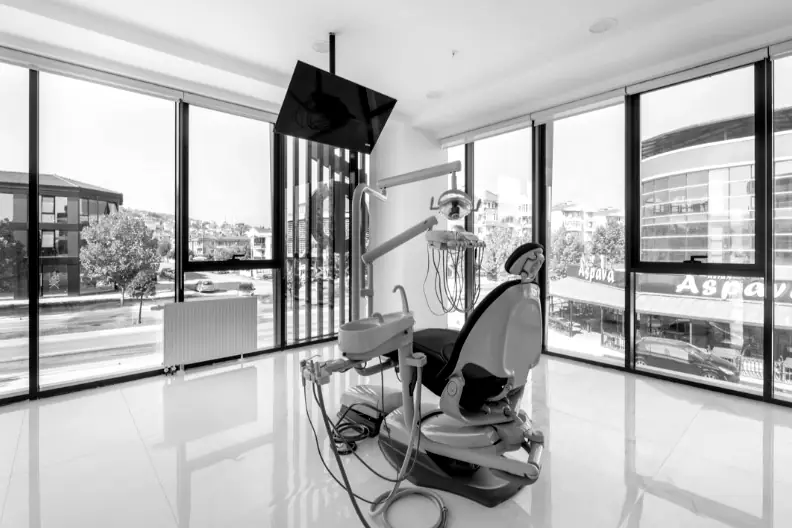
Treatment room and dental unit at Ev Diş
03 — Treatment room and natural daylight · Ev Diş, Sakarya Aesthetic Philosophy & Naturalness
“There are also small irregularities that are nature's signature: a slight rotation, subtle differences at the edges. If you erase them all, what emerges is not a tooth, but a piano key.”
— Dt. Emrah Özdemir
  • № 01 “A natural smile has no formula, but it has references that can be read.”
  • № 02 “We do not cut the tooth, but we prepare the surface carefully; because the boundary where the added material meets the gum is too fine to be seen with the naked eye.”
03.1 / Frequently asked questions
01

How is naturalness preserved in smile design?

The facial midline, how the upper incisal edges follow the lower lip, and age-appropriate translucency are evaluated together. The golden ratio is treated as a compass rather than a ruler, and the subtle irregularities that form nature's signature are not completely erased.

02

Can a smile be changed without cutting the tooth?

In healthy teeth whose shape or color can be improved with a minor intervention, the injection molding technique allows working without reducing the tooth. The new form is designed first and flowable composite is added through a transparent mold to complete what is missing. Whether this suits you is decided at the examination; it is not possible for every tooth.

03

Porcelain veneers or composite veneers?

Both serve the same purpose; which one is chosen is decided at the examination, based on the condition of the tooth and the patient. The extent of change needed, the remaining healthy enamel, chewing forces, age and maintenance habits are weighed together.

The boundary Emrah Özdemir draws for a natural smile:

“Someone looking at the smile should say 'what a lovely smile', not 'they had their teeth done'.”
Emrah Özdemir
04 /

Patient Approach

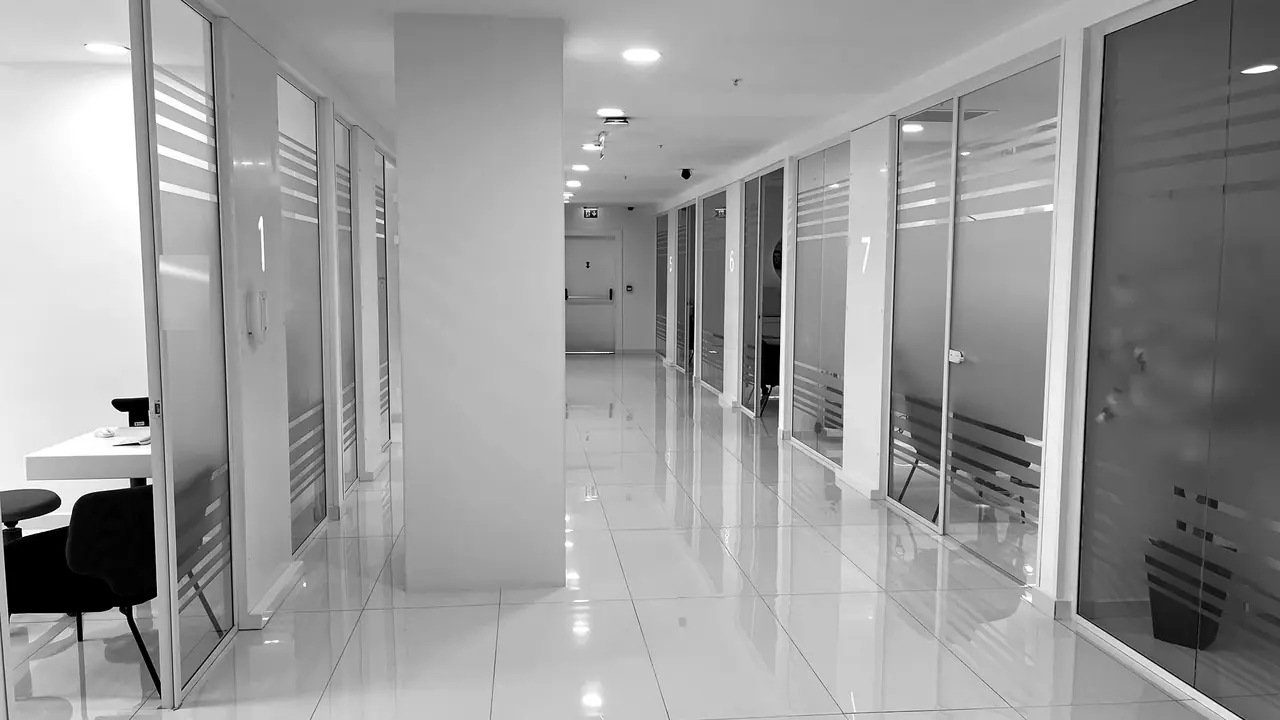
Corridor inside Ev Diş dental clinic
04 — Interior clinical architecture and quiet circulation space · Ev Diş, Sakarya Principles of Patient Care

Emrah Özdemir regards patient dialogue as an integral part of treatment and encourages younger colleagues to adopt the same discipline. When aesthetic requests exceed biological limits, he listens first, demonstrates the proposed change through digital smile design and an intraoral mock-up, and candidly explains how much healthy tooth structure would be lost and what maintenance will require ten years down the road.

I always begin by listening, because behind the request "I want ultra-white teeth" there is usually a deeper story: years of hiding a smile behind a hand, or feeling self-conscious in photographs. Dismissing that request with a flat "no" without understanding the underlying need is not good medicine. I treat conversation with the patient as part of the clinical procedure itself; any restoration performed without truly understanding the patient's expectations—no matter how well it is done—is a clinical failure.

Next, I show rather than merely tell: digital smile design and a temporary intraoral mock-up let us evaluate the result together in the mirror, where anything artificial immediately reveals itself against the patient's own facial features. I then explain transparently how much sound enamel would have to be sacrificed, how the gingiva will respond, and what maintenance or replacement will entail ten years from now. When a patient is given clear clinical facts, we almost always converge on a more conservative, natural treatment plan.

Thoughtful dentistry takes time; sitting down for an unhurried conversation with each patient is incompatible with an assembly-line clinic model. Once patients see an overly bright, uniform arch on their own face during a mock-up, they usually step back from that extreme on their own. However, if a request still crosses biological boundaries, declining that procedure is not merely my right—it is my professional duty. A clinician must be able to say gently, "I will not perform this procedure because it would harm your teeth."

“Saying no is also a treatment option.”
— Dt. Emrah Özdemir
  • № 01 “What the patient gains in the long run is healthy, irritation-free gingiva.”
05 /
CARD OF THE DAY · 2026-10-31 18 Verified Knowledge Cards

Tam dişsiz çenelerde All-on-4 ve All-on-6 implant üstü sabit hibrit protez planlamasında kemik hacmi ve biyomekanik yük dağılımı nasıl değerlendirilir?

Açılı yerleştirilen arka implantlar anatomik boşluklardan kaçınarak kemik grefti ihtiyacını azaltır; çiğneme kuvvetlerinin eşit dağıtımı için kemik yoğunluğuna göre 4 veya 6 implant seçilir.

Evidence-based clinical information cards derived from PubMed and Cochrane reviews · Professional clinical examination is essential. View Full Card Archive (18 Cards) →
06 /

Emrah Özdemir, Dentist

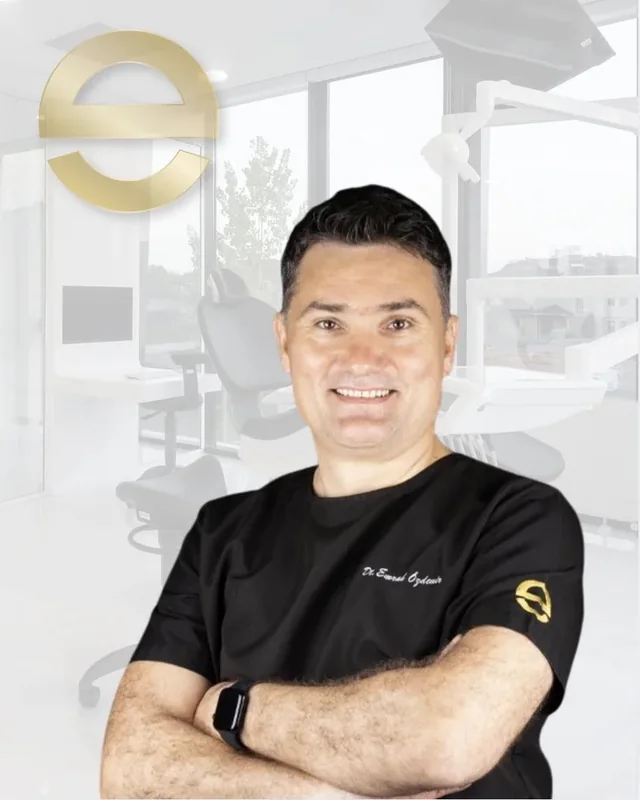
Portrait of Dt. Emrah Özdemir, Dentist at Ev Diş clinic
06 — Portrait of Dt. Emrah Özdemir, Dentist at Ev Diş clinic Biographical Note

Born in 1976 in Oltu, Erzurum. Married and father of three. He built his clinical practice on microscope-assisted preventive dentistry and minimally invasive aesthetic design that preserves healthy enamel.

Dentist Profile
Dt. Emrah Özdemir · Dentist
Education
Ankara University Faculty of Dentistry (1992–1997)
Focus areas
Aesthetic, digital, and preventive dentistry
Clinic
Ev Diş Oral and Dental Health Center (private clinic), Sakarya, Türkiye
07 /

Clinical Guides

GUIDE 01CONSERVATIVE APPROACH

Dental Aesthetics & Conservative Dentistry

Preserving healthy enamel first, composite bonding options, and staged treatment planning.

GUIDE 02CERAMIC RESTORATION

Porcelain Laminate Veneers

Clinical suitability criteria for thin ceramic veneers, mock-up trials, and comparison with crowns.

GUIDE 033D SCAN & MOCK-UP

Smile Design & Digital Planning

Three-dimensional intraoral scanning, facial-lip-tooth harmony, and temporary intraoral trial.

GUIDE 04ALL-CERAMIC CROWN

Zirconia & All-Ceramic Restorations

White ceramic substructure, light transmittance, gingival compatibility, and CAD/CAM workflow.

GUIDE 05MINIMALLY INVASIVE

Composite Bonding & Additive Aesthetics

Closing gaps, repairing fractures, and injection moulding without reducing sound enamel.

GUIDE 06PROSTHETIC HARMONY

Implant-Supported Aesthetic Prosthetics

Multidisciplinary surgical-prosthetic workflow at Ev Diş, emergence profile, and fixed restorations.

GUIDE 07ENAMEL SAFETY

In-Office & Home Tooth Whitening

Supervised bleaching protocols, managing temporary sensitivity, and pre-restorative shade stabilization.

GUIDE 08OCCLUSAL PROTECTION

Bruxism & Protective Night Guards

Sleep and awake clenching, preventing enamel and ceramic wear, and custom occlusal splints.

GUIDE 09OPTICAL SCANNING

3D Intraoral Scanning & Digital Impression

Tray-free 3D optical scanning comfort, CAD/CAM workflow, and accuracy compared with conventional impressions.

GUIDE 10PERIODONTOLOGY & GBT

Periodontology, Gum Care & Guided Biofilm Therapy (GBT)

Biofilm disclosure, warm erythritol Airflow prophylaxis, subgingival curettage, and pink aesthetics at Ev Diş.

GUIDE 11PEDIATRIC CLINIC

Pediatric Dentistry (Pedodontics) & Preventive Care

Dedicated children's clinic and play area, first dental visit, fissure sealants, fluoride varnish, and space maintainers.

GUIDE 12MICROSCOPE & CEREC

CEREC Digital CAD/CAM & Microscope Endodontics

Carl Zeiss dental microscope root canal therapy, retreatment, and CAD/CAM ceramic inlay/onlay restorations.

GUIDE 13 (TR)SEDATION & OPERATING SUITE

Conscious Sedation, General Anesthesia & Dental Anxiety Management (TR)

Full operating suite and recovery room at Serdivan Main Center, Left-Hand Rule patient control, gag reflex management, and single-session pediatric care.

CLINICAL INFRASTRUCTURE & EQUIPMENT MATRIXSERDİVAN MAIN CENTER · ADAPAZARI BRANCH

Ev Diş Oral and Dental Health Center — Branch & Technology Matrix

01 · SERDİVAN MAIN CENTER (İSTİKLAL MAH. 2. CAD. NO 13)

Full Operating Suite & Post-Anesthesia Recovery Unit (Conscious Sedation & General Anesthesia) · 3D Cone-Beam Computed Tomography (CBCT) & Cephalometric Radiology · 25x Dental Operating Microscope · CEREC CAD/CAM Digital Restorations & 3D Intraoral Optical Scanning · EMS Airflow Prophylaxis Master (GBT) · 8 Clinical Dental & Anesthesiology Specialties · Dedicated Pediatric Clinic & Play Area.

02 · ADAPAZARI BRANCH (YENİDOĞAN MAH. FABRİKA CAD. NO 33)

Digital Panoramic & Periapical Imaging · 3D Intraoral Optical Scanning & Digital Smile Planning · Conservative & Aesthetic Dentistry (Veneers, Zirconia, Composite Bonding) · Endodontics, Periodontology (GBT) & Pediatric Outpatient Care · Integrated coordination with Serdivan Main Center for 3D CBCT and operating-suite procedures.

Clinical Planning Guides · Ev Diş Oral and Dental Health Center · Serdivan & Adapazarı, Sakarya